Data centre coverage: when one repeater is not enough
By Jolene Wong
How I approach radio coverage in a data centre, what an OMU and ORU actually do, and what to ask before you sign.
Many of my coverage jobs end with one repeater and a few well-placed antennas. Data centres are where I have seen that stop being enough. I have worked on data centre radio projects and joined our engineers on site tests inside data centres. Here is what I learned, in plain words.
Why a data centre is hard on radio
A data centre is built to keep heat, dust and people out of the data halls. The same walls, steel and sealed doors keep radio signal out too. Many sites are also tall, with basements, or spread over more than one building, and everyone still needs to reach the control room.
What I plan for on a data centre job
- Coverage where people actually work and walk, not only where the antennas are easy to fit. Stairwells and plant rooms are where I see radios fail first.
- Proof, not promises: a site test before the design, and a walk test at handover.
- Certified equipment. In Malaysia that means SIRIM for the radios and the coverage units, and an MCMC licence for the system.
- Paperwork early. Data centres usually want a method statement and a risk assessment (such as HIRARC) approved before anyone starts, and work only in approved hours.
- No gap in radio contact. The old system keeps running until the new one is accepted.
What an OMU and ORU do
Think of it as taking the repeater to every part of the site without moving it. The repeater stays in the equipment room, and the OMU, the optical master unit, sits beside it. The OMU turns the radio signal into light and sends it over optical fibre. Out in the building, an ORU, the optical remote unit, turns the light back into radio signal and feeds the antennas in its zone. When someone talks on a portable radio there, the ORU sends it back to the OMU the same way.
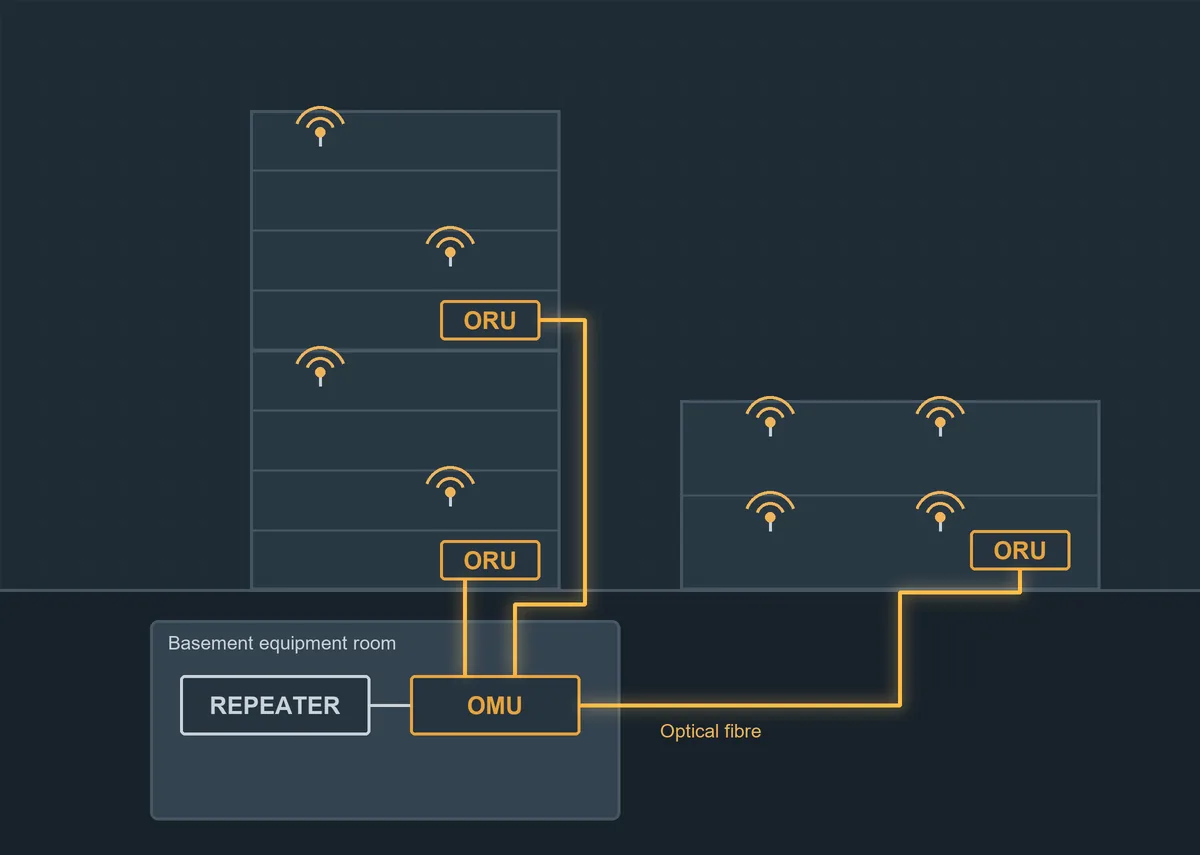
How many units a site needs comes from the site test and the design. The FMTCS units I work with are on their product page.
Why fibre and not more coaxial cable
Coaxial cable loses signal along its length, so a long run between buildings eats into the coverage you paid for. Fibre carries the signal much further with very little loss, and the ORU amplifies it again at the far end, close to the people who need it.
When I would not use it
If the whole site is one building with a basement, a repeater with a good antenna layout is often enough, and it costs less. A fibre system makes sense when the site has several blocks, is very tall, or is full of sealed rooms that one antenna point cannot reach. I decide after the site test, not before.
What to ask before you sign
- Is every piece of equipment SIRIM certified, and can I see the certificates?
- Which fibre will the system use? Spare single-mode fibre already on site can save new cabling.
- What happens to the current system during the change, and what is the fallback?
- How will the coverage be proven at handover, point by point?
- Who handles the MCMC licence? Every repeater system needs one.
If you run a data centre or a large campus and your radios drop between blocks, send me the site plan and the places that fail. I will tell you honestly whether you need fibre or just a better antenna layout.